Machine learning for kids is an engaging way to introduce children to artificial intelligence (AI), computer science, and modern technology. As technology continues to transform education and everyday life, helping children understand how machines learn and make decisions has become increasingly important.
Machine learning allows computers to identify patterns, recognize information, make predictions, and improve their performance using data. Through child-friendly activities, games, and creative projects, students can explore these concepts without needing advanced mathematics or programming knowledge.
Learning machine learning at an early age can develop problem-solving abilities, logical thinking, creativity, and digital literacy. It also helps children understand the technology behind voice assistants, recommendation systems, facial recognition, and other intelligent applications.
Whether parents are looking for educational activities at home or teachers want to introduce artificial intelligence into classrooms, machine learning offers exciting opportunities for hands-on learning.
What Is Machine Learning for Kids?
Machine learning for kids refers to educational activities and learning resources that introduce children to the basic concepts of machine learning and artificial intelligence.
Instead of simply following instructions programmed by humans, machine learning systems use examples and data to identify patterns and make predictions.
For example, children can train a computer to recognize pictures of cats and dogs. After showing the computer several labeled examples, they can test whether it can identify new pictures correctly.
This simple activity demonstrates how machines learn from data.
Machine learning education for children generally focuses on three important areas:
- Understanding AI: Learning what artificial intelligence is and how computers perform intelligent tasks.
- Learning from data: Understanding how computers identify patterns through examples.
- Creating projects: Building simple machine learning applications using beginner-friendly tools.
The main objective is to make technology understandable, interactive, and enjoyable for young learners.
Why Should Kids Learn Machine Learning?
Introducing machine learning to children can provide valuable educational benefits. It helps them understand the digital world while developing skills that can support their academic and professional growth.
Here are some important reasons children should explore machine learning.
1. Develops Problem-Solving Skills
Machine learning activities encourage children to examine problems, test ideas, and find solutions. When a model produces an incorrect prediction, students can investigate the reason and improve their training examples.
2. Encourages Creativity
Children can use machine learning to create interactive games, educational applications, digital stories, and other projects. These activities allow them to combine imagination with technology.
3. Builds Logical Thinking
Understanding how computers identify patterns helps children develop logical reasoning. They learn to organize information, compare results, and recognize relationships between different examples.
4. Introduces Future Career Skills
Artificial intelligence is becoming increasingly important across industries. Early exposure can help students explore future opportunities in computer science, robotics, data science, and software development.
5. Improves Digital Literacy
Children learn that computers do not automatically understand information like humans. They need data, training, and appropriate instructions to produce useful results.
How Does Machine Learning Work?
Machine learning works by using data to train a computer model. The model analyzes examples, identifies patterns, and uses those patterns to make predictions about new information.
Children can understand the basic process through simple everyday examples.
Imagine teaching a computer to recognize different types of fruit. First, students provide pictures labeled as apples, bananas, and oranges. The machine learning model examines these examples and learns to identify patterns.
After training, students provide new fruit pictures and ask the computer to classify them.
The basic machine learning process includes four stages.
| Stage | What Happens |
|---|---|
| Data collection | Gather examples for training |
| Training | The computer studies the examples |
| Testing | Check how accurately the model makes predictions |
| Improvement | Add better examples and improve the model |
This process teaches children that machine learning depends on the quality and variety of the information provided.
Best Machine Learning Activities for Kids
Hands-on activities are one of the easiest ways to introduce children to artificial intelligence. They make complicated ideas easier to understand and encourage active participation.
Here are some beginner-friendly activities.
1. Teach a Computer to Recognize Animals
Children can create a simple image recognition project using pictures of different animals.
They can collect pictures of cats, dogs, birds, and other animals. After organizing the images into categories, they can train a machine learning model to recognize them.
This activity introduces image classification and pattern recognition.
2. Build a Rock-Paper-Scissors Prediction Game
Children can explore how machine learning systems recognize patterns in repeated activities.
They can create a simple game in which a computer analyzes previous choices and attempts to predict the next move.
This activity introduces prediction, data collection, and basic model evaluation.
3. Create a Voice Recognition Project
With appropriate tools and adult supervision, children can explore how computers recognize spoken words.
They can train a model to distinguish between simple spoken commands, such as hello, stop, or start.
This activity introduces speech recognition and audio classification.
4. Create a Recycling Classifier
Children can train a computer to recognize different categories of waste, such as paper, plastic, and metal.
The project can introduce environmental awareness while teaching image classification.
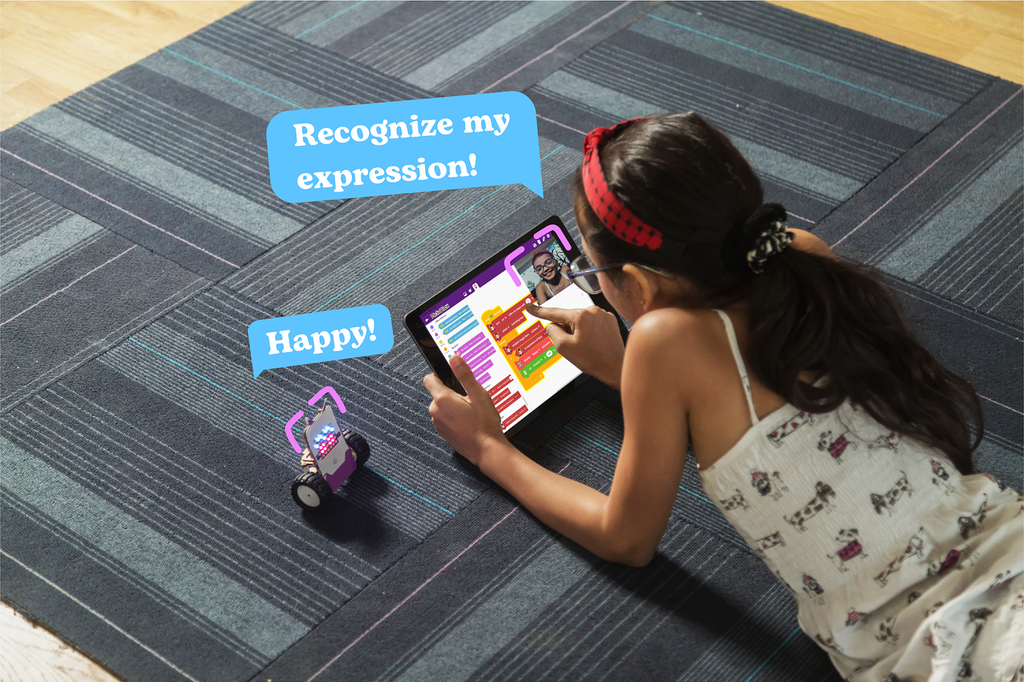
5. Build a Simple Emotion Recognition Demonstration
Children can explore how computers analyze facial expressions in educational demonstrations.
This activity should be handled carefully because facial expressions do not reliably reveal a person’s actual emotions. Students should understand the limitations and potential biases of AI systems.
Best Machine Learning Tools for Kids
Several beginner-friendly platforms make it easier for children to experiment with machine learning. Some offer visual interfaces that reduce the need for writing complicated code.
1. Machine Learning for Kids
This educational platform introduces machine learning through practical projects. Children can train models using text, numbers, and images and use them in creative coding activities.
2. Google Teachable Machine
Teachable Machine allows beginners to train simple machine learning models using images, sounds, and body poses. It is useful for quick experiments without traditional programming.
3. Scratch
Scratch introduces children to programming through colorful coding blocks. It can also be combined with suitable AI extensions and learning activities to explore machine learning concepts.
4. Code.org
Code.org provides beginner-friendly computer science and AI learning activities. Its educational resources help students explore computational thinking and technology.
5. Python
Older children with some programming experience can explore machine learning using Python. It offers opportunities to understand datasets, algorithms, and introductory artificial intelligence projects.
Machine Learning Projects for Different Age Groups
Children learn technology at different speeds. Therefore, machine learning activities should match their age, interests, and existing knowledge.
| Age Group | Suitable Activities | Learning Goals |
|---|---|---|
| 5–7 years | Pattern games and sorting activities | Recognizing patterns |
| 8–10 years | Image classification and simple AI games | Understanding machine learning |
| 11–13 years | Text recognition and interactive projects | Exploring data and predictions |
| 14–16 years | Python-based machine learning projects | Learning algorithms and coding |
| 17–18 years | Data analysis and introductory AI applications | Developing technical knowledge |
Younger children can begin with games and visual demonstrations, while older students can explore programming and more advanced concepts.
Machine Learning for Kids Without Coding
Children do not need programming experience to start learning machine learning. Several educational tools provide visual interfaces that allow students to train models without writing traditional code.
No-code learning is especially useful for beginners because it allows them to focus on understanding how machine learning works.
For example, students can use an image recognition tool to create a model that identifies different objects.
The process generally involves:
- Choosing a simple project.
- Collecting relevant examples.
- Organizing examples into categories.
- Training the machine learning model.
- Testing the model with new information.
- Reviewing and improving the results.
These activities help children understand the relationship between data and predictions before they begin learning programming languages.
Important Machine Learning Concepts Kids Should Understand
Children do not need to study complex mathematical formulas initially. However, understanding a few basic concepts can help them develop a strong foundation.
| Concept | Simple Explanation |
|---|---|
| Artificial intelligence | Technology that performs tasks associated with human intelligence |
| Machine learning | Computers learning patterns from data |
| Data | Information used to train a computer |
| Algorithm | A set of steps used to solve a problem |
| Training | Teaching a model using examples |
| Prediction | A model’s estimated answer |
| Classification | Organizing information into categories |
| Accuracy | How often a model makes correct predictions |
| Bias | An unfair or unbalanced result caused by data or system design |
These concepts provide a useful starting point for understanding modern AI technologies.
How Parents Can Teach Machine Learning at Home
Parents can introduce machine learning through everyday activities without requiring expensive equipment or advanced technical knowledge.
The best approach is to begin with familiar examples and gradually introduce more complicated concepts.
Start With Everyday Technology: Explain how recommendation systems suggest videos, how voice assistants respond to commands, and how email applications identify unwanted messages.
Use Interactive Learning Platforms: Beginner-friendly educational platforms allow children to experiment with machine learning through simple projects.
Encourage Questions: Ask children why a computer makes a particular prediction and whether its answer is always correct.
Build Small Projects: Begin with an image classifier, a simple text recognition activity, or a pattern-based game.
Discuss Responsible AI: Explain why personal information should be protected and why computer-generated answers should not always be trusted.
Parents should focus on curiosity and practical learning rather than expecting children to master advanced technical concepts immediately.
Benefits of Machine Learning in School Education
Machine learning can support modern education by making lessons more interactive and helping students understand complex topics through practical examples.
Schools can introduce artificial intelligence through computer science classes, science projects, mathematics activities, and interdisciplinary learning.
Some important educational benefits include:
- Personalized learning: AI-based educational applications can adapt certain learning activities to individual student needs.
- Interactive lessons: Students can experiment with data and observe how computer models behave.
- Critical thinking: Children learn to evaluate predictions rather than automatically accepting computer-generated answers.
- Collaboration: Group projects encourage communication and teamwork.
- Technology awareness: Students become familiar with digital tools and emerging technologies.
Teachers can also use machine learning projects to connect computer science with subjects such as environmental studies, mathematics, and science.
Safety and Ethical Considerations When Teaching Kids AI
Machine learning education should include responsible technology use. Children need to understand that AI tools can make mistakes and may produce inaccurate, biased, or misleading results.
Parents and teachers should discuss important safety practices before allowing children to experiment with online platforms.
Some essential guidelines include:
- Avoid sharing personal information with AI tools.
- Use age-appropriate educational platforms.
- Ask an adult before creating online accounts.
- Check the accuracy of AI-generated information.
- Avoid uploading private photographs or recordings.
- Understand that training data can influence model predictions.
- Respect other people’s privacy and intellectual property.
Children should also learn that artificial intelligence is a tool created and managed by humans. It should support learning and creativity rather than replace independent thinking.
Future Career Opportunities in Machine Learning and Artificial Intelligence
Machine learning is becoming increasingly important in industries such as healthcare, finance, education, manufacturing, transportation, and entertainment.
Introducing these technologies to children can help them discover potential career interests.
Some future career pathways include:
| Career | What Professionals Do |
|---|---|
| Machine Learning Engineer | Develops and improves machine learning systems |
| Data Scientist | Analyzes information and identifies patterns |
| AI Developer | Creates artificial intelligence applications |
| Robotics Engineer | Develops intelligent robotic systems |
| Software Developer | Builds computer programs and applications |
| AI Researcher | Studies new artificial intelligence methods |
| Data Analyst | Examines data to support decisions |
Children do not need to choose a career at an early age. Instead, exploring machine learning can help them discover their interests and develop useful technical skills.
How to Create a Beginner Machine Learning Project
Creating a simple project is an excellent way to understand machine learning. An image classification activity is a good starting point for beginners.
Step 1: Select a Project Idea
Choose something simple, such as teaching a computer to recognize apples and bananas.
Step 2: Collect Training Data
Gather several images of each fruit. Make sure the images show different backgrounds, sizes, and angles.
Step 3: Organize the Images
Create separate categories for apples and bananas. Correctly labeled examples help the model learn.
Step 4: Train the Model
Use a beginner-friendly machine learning platform to process the images and identify patterns.
Step 5: Test the Results
Upload new images that were not included in the training data. Observe whether the model identifies the fruit correctly.
Step 6: Improve the Model
If the predictions are incorrect, review the training examples and add more varied images.
This project introduces children to data collection, model training, testing, and improvement through an enjoyable learning experience.
Conclusion
Machine learning for kids is an effective way to introduce children to artificial intelligence, computer science, and modern technology. Through interactive activities, beginner-friendly platforms, and creative projects, students can understand how computers learn from data and make predictions.
Learning these concepts can improve problem-solving, logical reasoning, creativity, and digital literacy. Parents and teachers can begin with simple activities before introducing coding and more advanced machine learning projects.
As artificial intelligence continues to influence everyday life, helping children understand how it works can prepare them to become informed, responsible, and creative technology users.
Frequently Asked Questions About Machine Learning for Kids
What Is the Best Age to Start Learning Machine Learning?
Children can begin exploring basic machine learning concepts around the age of 5 to 7 through pattern games, sorting activities, and simple demonstrations. More structured machine learning projects are generally suitable for children aged 8 and above, depending on their interests and learning abilities.
Can Kids Learn Machine Learning Without Coding?
Yes, children can learn machine learning without coding by using beginner-friendly platforms such as Google Teachable Machine and Machine Learning for Kids. These tools allow students to train models using images, sounds, and text through visual interfaces.
Is Machine Learning Difficult for Beginners?
Machine learning can involve advanced mathematics and programming at higher levels, but its basic concepts are easy to introduce through simple activities. Children can start by recognizing patterns, sorting information, and training basic classification models.
What Are Some Easy Machine Learning Projects for Kids?
Easy projects include creating an animal recognition model, building a fruit classifier, developing a simple recycling classifier, exploring voice recognition, and creating pattern-based prediction games. These projects help children understand how computers learn from examples.
Why Is Machine Learning Important for Children’s Future?
Machine learning is important because artificial intelligence is becoming part of many industries and everyday applications. Understanding its basic principles helps children develop digital literacy, critical thinking, problem-solving abilities, and an early foundation for exploring future technology careers.
| Read More : Cybersecurity ETF: Meaning, Benefits, |
One thought on “Machine Learning for Kids: A Complete Guide to Teaching Artificial Intelligence to Children”